Ask people outside clowning what skills matter most and you’ll usually hear the same answers:
Makeup.
Juggling.
Balloon twisting.
Magic.
Comedy.
Costumes.
Those things matter.
But none of them are the most important skill.
The most important skill in clowning is awareness.
Awareness changes everything.
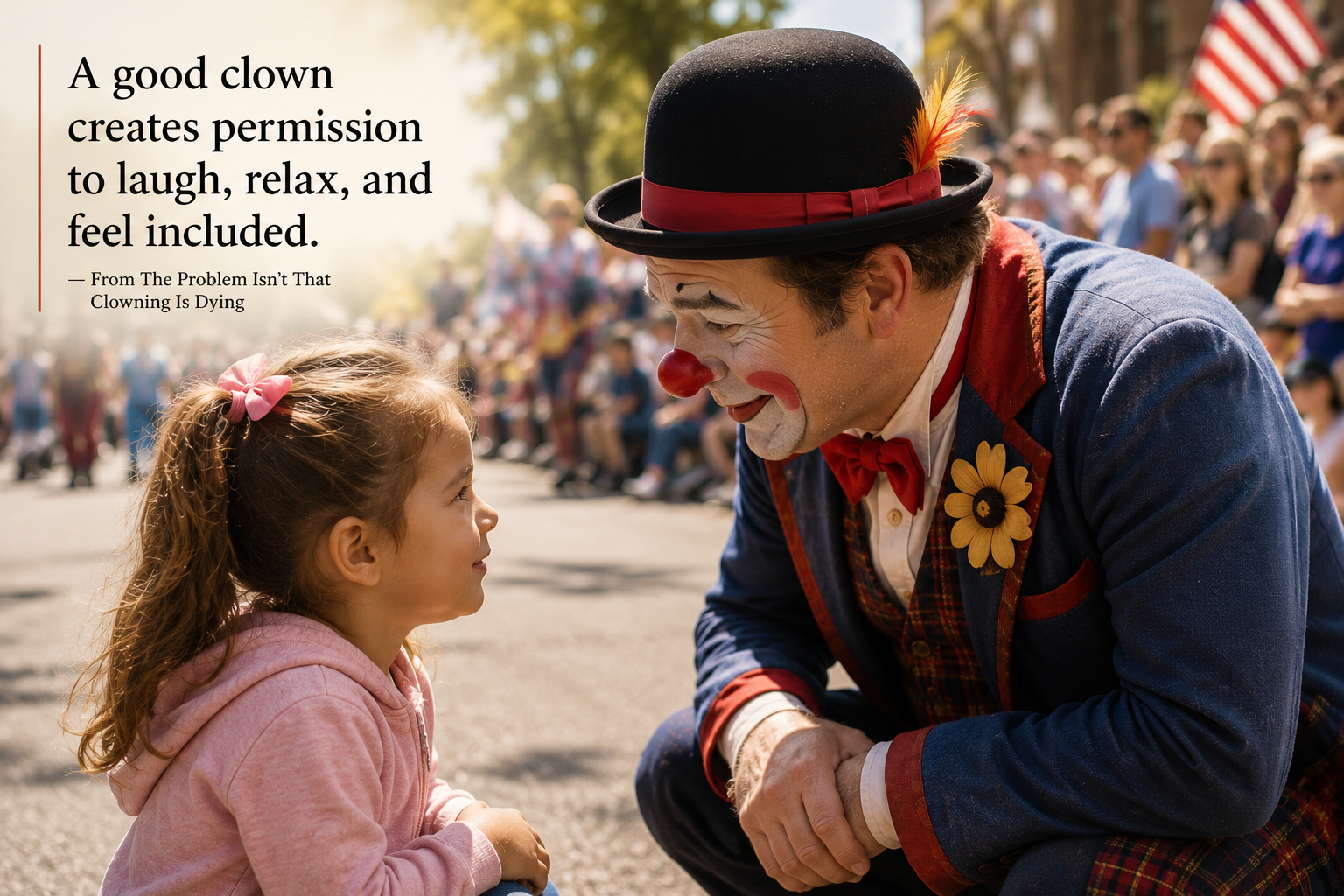
It tells you when a child is nervous instead of excited.
It tells you when a crowd is engaged or exhausted.
It tells you when to approach and when to back away.
It tells you when a gag needs to end.
It tells you when silence is more powerful than noise.
Without awareness, even talented performers become overwhelming.
One of the biggest mistakes inexperienced clowns make is assuming every person wants interaction at the same level. They approach every audience member with identical energy. Same volume. Same distance. Same pacing.
But good clowns read people first.
Some children immediately run toward a clown.
Others need space.
Some adults want to participate.
Others prefer observation.
Some crowds want chaos.
Others respond better to gentleness.
A skilled clown adjusts constantly.
That flexibility is far more valuable than memorizing fifty balloon animals or owning expensive props.
The audience should never feel trapped by a clown.
They should feel invited.
That distinction matters enormously.
I’ve watched technically talented performers accidentally create discomfort simply because they never learned how to read a room. And I’ve watched very simple performers completely win over audiences because they paid attention to emotional pacing.
Awareness also protects dignity.
A clown should never become so focused on getting laughs that they embarrass people unnecessarily. Humor built entirely on humiliation usually creates short-term reactions and long-term discomfort.
The strongest clown interactions leave people feeling included, not targeted.
That requires emotional intelligence.
And emotional intelligence is harder to teach than makeup design.
Awareness also helps performers recover from mistakes. Every clown fails. Props break. Jokes die. Timing disappears. Kids say unpredictable things. Outdoor performances become chaotic.
A rigid performer panics.
An aware performer adapts.
Sometimes the recovery becomes funnier than the original routine.
That’s one of the hidden truths of clowning:
control is overrated.
Connection matters more.
The audience does not need perfection from a clown. In many ways, they expect imperfection. What they respond to is honesty, flexibility, and presence.
A clown who is fully present in the moment will almost always outperform a clown trapped inside a rehearsed script.
Because people remember interactions far more than routines.
That’s why awareness is not just another skill in clowning.
It’s the foundation underneath all the others.
Smokie
Bringing joy and laughter since 1946
The most important skill in clowning has nothing to do with makeup