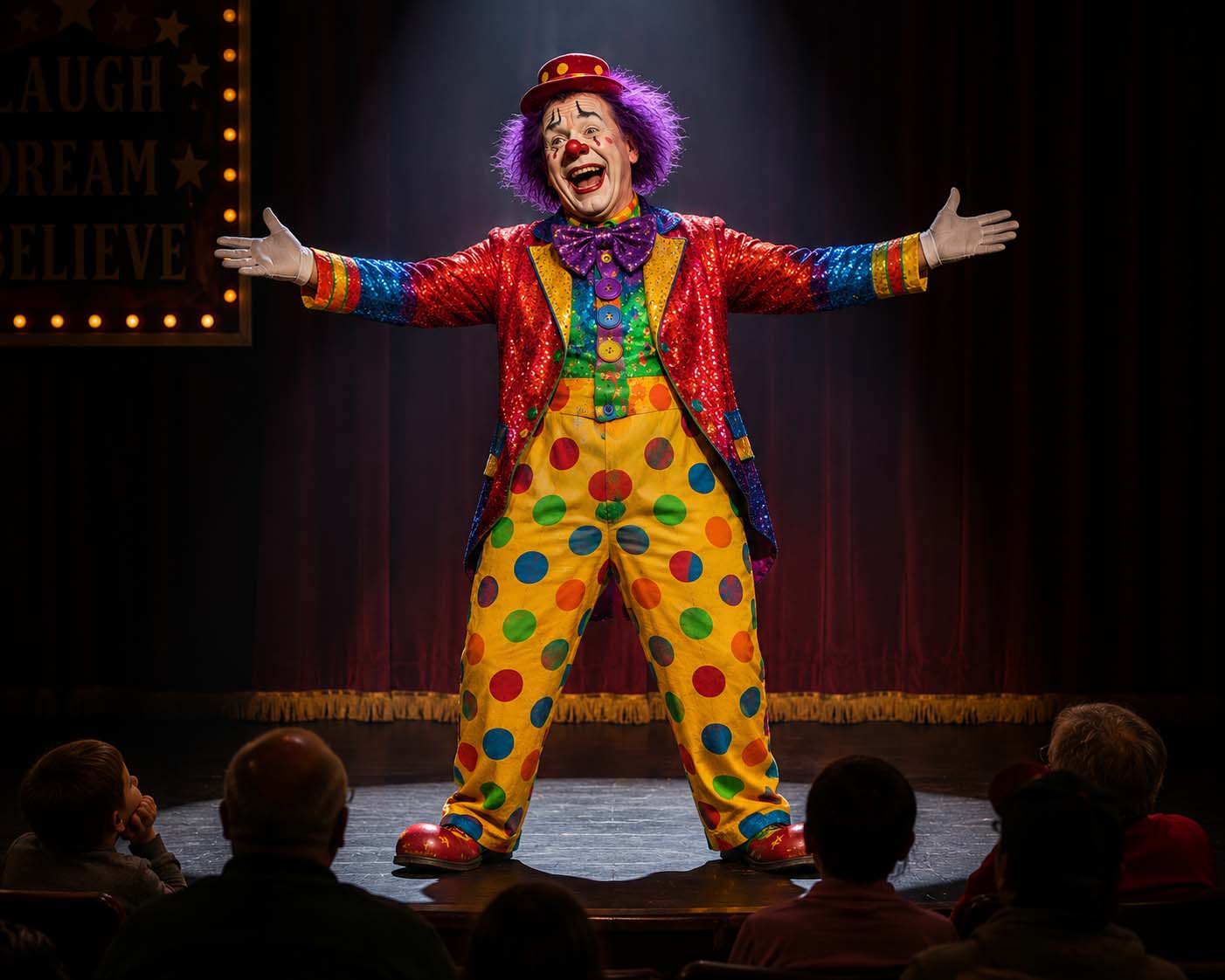
The Problem Isn’t That Clowning Is Dying It’s That Too Many Clowns Forgot What Matters
Somewhere along the way, too many people started believing clowning was about the makeup.
It isn’t.
Makeup is decoration. Props are tools. Costumes are signals. The real work begins when you stand in front of another human being and try to make them feel something.
That’s the part people forget.
I’ve seen performers with beautiful costumes, expensive props, custom wigs, and flawless makeup completely lose an audience because there was nothing underneath it all. No connection. No awareness. No honesty. Just noise.
And I’ve seen clowns with wrinkled costumes, simple makeup, and almost no equipment completely light up a crowd because they understood people.
That difference matters.
A lot of modern conversations about clowning focus on survival. How do we recruit? How do we modernize? How do we stay relevant? How do we get younger performers interested again?
Those are fair questions.
But I think we avoid a harder one:
Have we accidentally taught people that clowning is mostly appearance instead of connection?
Because audiences don’t remember every joke.
They remember how you made them feel.
They remember the clown who knelt down to talk to a nervous child instead of towering over them. They remember the clown who made grandma laugh when she looked exhausted at a parade. They remember the performer who treated people like they mattered instead of treating the performance like a spotlight competition.
That is clowning.
Not just the gags.
Not just the makeup.
Not just the applause.
Connection.
Somewhere along the line, parts of clown culture became too focused on surface-level things. Bigger props. Louder costumes. More competition. More ego. More attention on who gets recognized instead of who actually reaches people.
And audiences can feel that immediately.
You cannot fake sincerity in clowning.
You can fake confidence for a little while.
You can fake energy.
You can fake enthusiasm.
But you cannot fake heart.
An audience always knows when a clown is performing at them instead of with them.
That’s why some performers can hold attention with almost nothing. No giant production. No elaborate setup. Sometimes just a look, a pause, or a simple interaction becomes the biggest laugh of the day.
Because the audience feels included.
The best clowns understand that the audience is not an obstacle between them and applause. The audience is the entire reason the performance exists.
That philosophy changes everything.
It changes how you build a character.
It changes how you approach makeup.
It changes how you interact with children.
It changes how you handle mistakes.
It changes how you treat other performers.
A good clown understands that the job is not to look funny.
The job is to create permission.
Permission for people to laugh.
Permission for people to be silly.
Permission for people to relax.
Permission for people to feel joy for a moment without embarrassment.
That takes vulnerability. More than most people realize.
The irony is that clowning has never actually been about pretending to be perfect. Historically, the clown has almost always been the most human person in the room. The one who fails publicly. The one who struggles openly. The one who keeps trying anyway.
That’s why audiences connect with clowns when it’s done well.
And maybe that’s why bad clowning feels so uncomfortable. Because when there’s no honesty underneath the character, the audience senses the emptiness immediately.
I don’t believe clowning is dying.
I think people are still desperately searching for authentic joy, authentic interaction, and authentic laughter. In many ways, they probably need it more now than they ever have.
But I do think parts of clowning have drifted away from the emotional core that made the art form matter in the first place.
The future of clowning probably won’t be saved by bigger shoes, louder jackets, or more social media clips.
It will be saved by performers who remember what the art was always supposed to be about:
Connection.
The clowns who last are usually not the ones trying hardest to become famous.
They’re the ones who make people feel seen.
Smokie
Bringing joy and laughter since 1946
Don’t forget the why