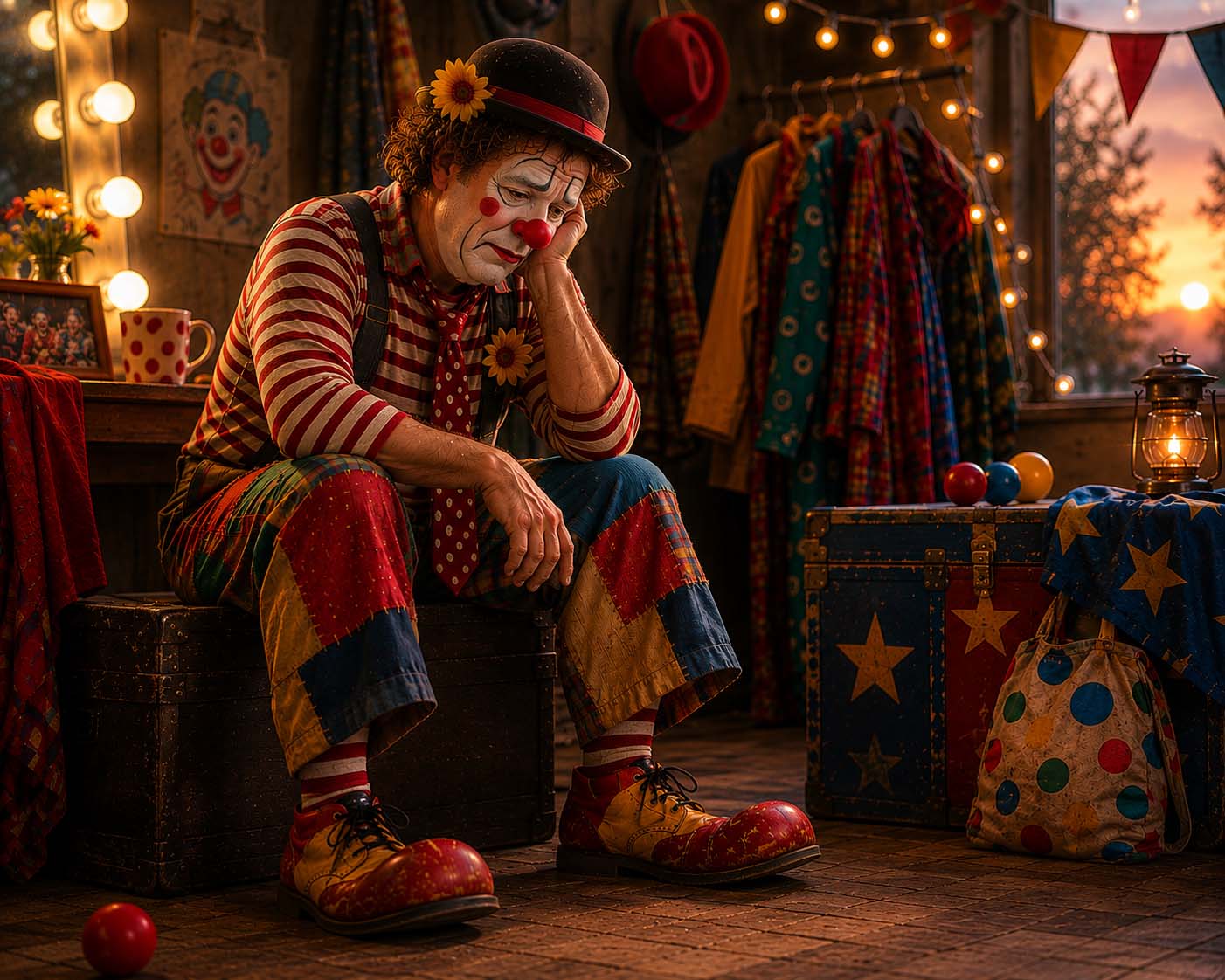
Nobody talks enough about burnout in clowning.
Maybe because people assume clowns are supposed to be endlessly cheerful. Maybe because performers feel guilty admitting exhaustion in an art form built around joy.
But burnout is real.
And it usually doesn’t happen because someone performed too much.
It happens because they slowly stopped feeling connected to why they started.
At first, clowning feels electric.
You discover the reactions.
The laughter.
The energy.
The freedom.
The strange magic of making complete strangers smile.
Then, somewhere along the line, things can shift.
The pressure starts creeping in.
Who’s getting booked?
Who’s getting recognized?
Who wins competitions?
Who gets applause?
Who gets invited back?
Who gets attention online?
Without realizing it, some performers slowly stop chasing connection and start chasing validation.
That’s where burnout begins.
Because validation is impossible to satisfy for long.
There will always be another performer.
Another costume.
Another convention.
Another routine.
Another person getting attention.
And if your sense of worth depends entirely on external recognition, clowning eventually becomes emotionally exhausting instead of life-giving.
The irony is that many burned-out clowns are incredibly talented.
But somewhere along the way they stopped allowing themselves to simply enjoy people.
Everything became pressure.
Pressure to impress.
Pressure to stay relevant.
Pressure to prove themselves.
Pressure to matter.
And eventually the joy gets squeezed out.
I think some performers also quietly carry another burden:
They feel like they must always be “on.”
Always funny.
Always energetic.
Always entertaining.
But real clowning has never been about pretending to be superhuman.
In fact, the clown has historically been the most openly flawed person in the room.
That’s what audiences connect with.
The clown struggles.
The clown fails.
The clown gets back up.
The clown keeps trying anyway.
That honesty is not weakness.
It’s the entire heartbeat of the art form.
One of the healthiest things a performer can do is reconnect with smaller moments again.
A quiet interaction at a parade.
A nervous child finally smiling.
A simple walkaround gag that unexpectedly works.
A conversation with another clown after an event.
A memory made backstage.
Those moments matter more than most trophies ever will.
And mentorship matters too.
Burnout grows fastest in isolation.
Some performers stop surrounding themselves with people who challenge them, encourage them, or remind them why the art matters in the first place. Instead, they become trapped in comparison and politics.
That slowly poisons creativity.
The healthiest clown communities are not built entirely around competition.
They’re built around growth.
Learning together.
Failing together.
Sharing ideas.
Helping new performers.
Passing knowledge forward.
That kind of environment keeps the art alive because it keeps people emotionally connected to it.
I don’t think the answer to burnout is simply “work less.”
I think the answer is remembering why the work mattered to begin with.
Because the truth is, clowning at its best does something rare.
It gives people permission to feel human again.
And sometimes performers need that reminder just as much as the audience does.
Smokie
Bringing joy and laughter since 1946
The real reason some clowns burn out