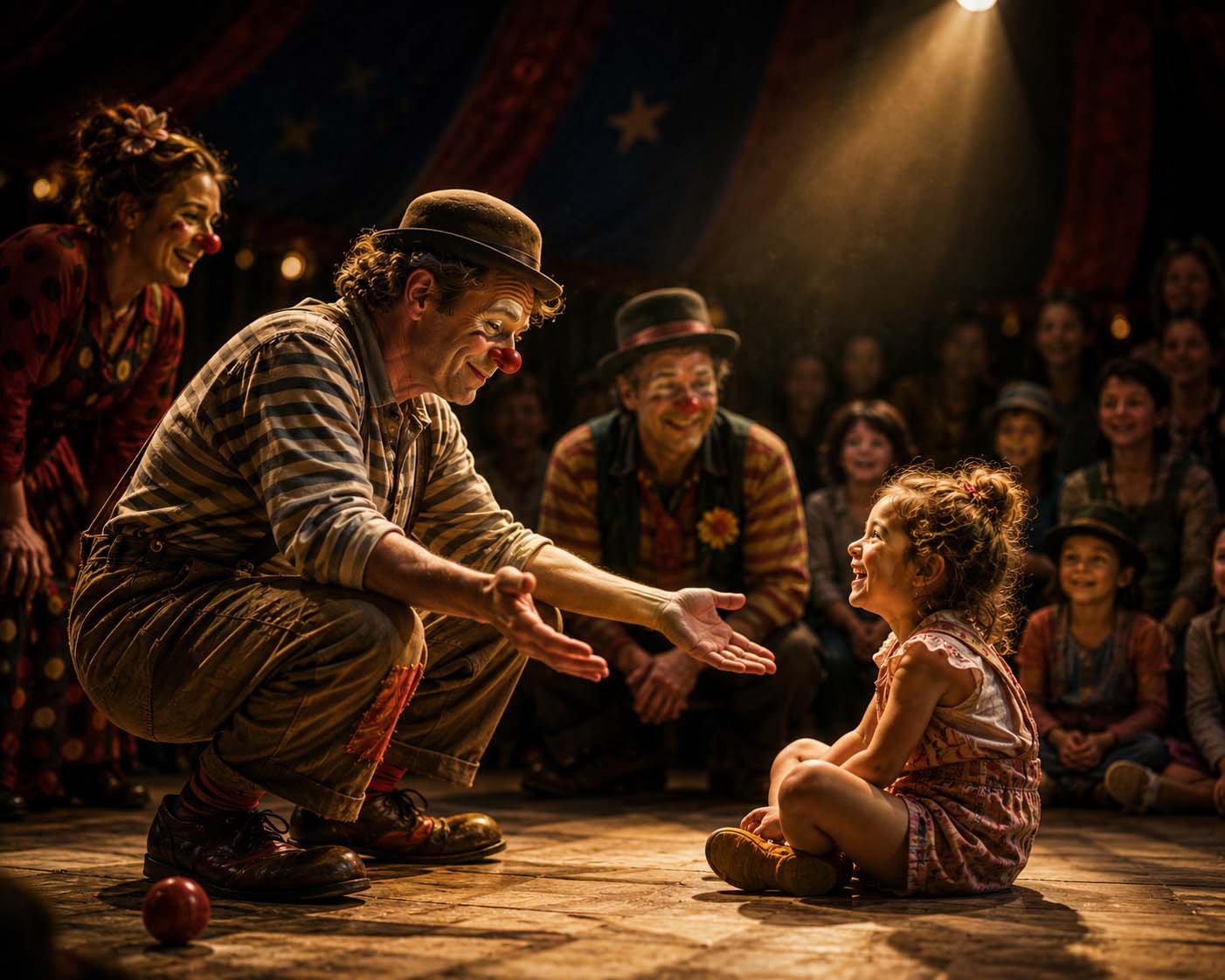
A lot of performers enter clowning thinking the goal is to become hilarious.
That makes sense on the surface. Clowns make people laugh. Comedy matters. Timing matters. Humor matters.
But the best clowns I’ve ever watched were rarely obsessed with being the funniest person in the room.
They were focused on being the most connected.
That’s different.
There’s a version of performance built entirely around attention. Bigger reactions. Bigger noise. Bigger moments. Some performers treat every interaction like a competition they need to win.
But clowning has never worked best as domination.
It works best as invitation.
The strongest clowns understand that laughter is not something you force out of people. It’s something you build together.
That requires generosity.
And generosity is surprisingly rare in entertainment.
Some performers are so focused on appearing clever that they forget to leave space for others. The audience becomes passive instead of involved. Fellow performers become obstacles instead of partners.
But great clowns make everyone around them better.
They elevate scenes instead of stealing them.
They share focus naturally.
They react honestly.
They support weaker performers instead of exposing them.
They understand rhythm instead of constant escalation.
That kind of performer becomes magnetic.
Ironically, those are often the people audiences remember longest.
Not because they demanded attention but because they created experience.
One of the hardest lessons for performers to learn is that silence can sometimes be stronger than noise!
A small reaction can outperform a giant one.
A pause can outperform shouting.
A glance can outperform a speech.
The audience doesn’t just watch what a clown does.
They watch what the clown notices.
That’s where character lives.
The best clowns are deeply aware of the emotional atmosphere around them. They understand pacing. They understand buildup. They understand restraint.
Restraint is important because audiences get exhausted by performers who are constantly trying to peak every moment emotionally.
Good clowning breathes.
It rises and falls naturally.
That rhythm creates authenticity because real people are not operating at maximum volume every second of the day.
And maybe that’s why audiences connect more deeply with performers who feel emotionally honest instead of mechanically funny.
The clown becomes recognizable.
Human.
Flawed.
Trying.
That matters.
I think younger performers sometimes underestimate how much humility exists inside truly great clowning. The strongest performers are often incredibly generous backstage. They mentor freely. They encourage others. They stay curious. They continue learning long after they could have comfortably stopped.
Because deep down, they understand something important:
Clowning is not about proving you’re the most important person in the room.
It’s about helping the room feel more alive after you entered it.
Smokie

Bringing joy and laughter since 1946
The best clowns don’t try to be the funniest person in the room